← Back to Articles
Article
Social Media Cannot Be News: A Wake-Up Call for India's Legislature.
By Lt Gen A B Shivane PVSM, AVSM, VSM (Retd.)
August 3, 2026
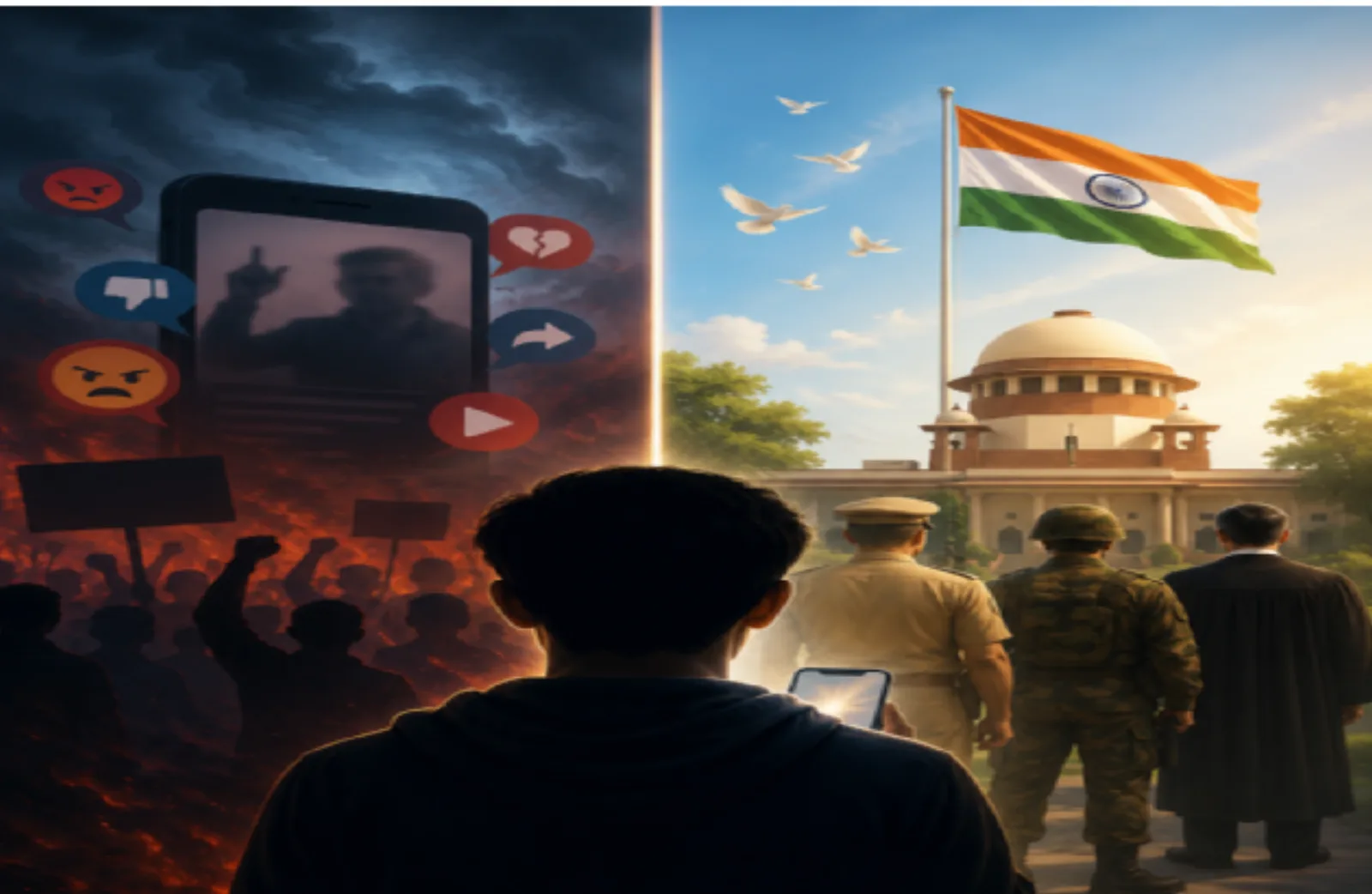
A rumour needs no passport to cross a border in India today. It needs only a smartphone. A morphed video of a police lathi-charge, a fabricated order attributed to a judge, and a fake press release citing an army unit that does not exist each travel from a bedroom in a small town to a million screens before any newsroom, any court, or any regiment has the chance to respond. By the time the truth catches up, the lie has already done its work: a crowd has gathered, a young man has thrown a stone, and a national institution has been made to look weak in the eyes of the very citizens it protects. This is not an accident of technology. It is the deliberate exploitation of an unregulated space, and it is happening to the most impressionable segment of the population, India's youth.
The scale of the shift is no longer disputed. The Reuters Institute's Digital News Report 2026, the most comprehensive annual survey of news habits worldwide, found that social media and video platforms have, for the first time, overtaken television and the websites of established news organisations as the leading source of news globally. In India, nearly six in ten respondents said they turn to YouTube for news. Among those aged eighteen to twenty-four, more than half now cite social media, video platforms, or AI chatbots as their primary source of information. Meanwhile, trust in that information has fallen to its lowest level since 2015. India's youth are, in effect, being educated about their own country, their own police, their own courts, and their own armed forces by algorithms built to maximise engagement rather than accuracy.
This is the paradox that Indian policy has failed to confront. A generation that will vote, serve, and eventually lead is forming its view of the Republic not from the Constitution, not from a courtroom transcript, not from a verified news report, but from a fifteen-second reel optimised to provoke outrage. Outrage travels faster than fact. A platform's business model rewards posts that inflame, not those that clarify. When that engine is directed at the judiciary, the police, or the armed forces, the damage is not confined to reputation. It corrodes citizens' willingness to trust the institutions that hold the Republic together, and it does so at the very age when that trust is still being formed.
India has not been blind to the problem, but its response has been incremental, even though the threat is structural. The Information Technology Rules of 2021 established a three-tier grievance mechanism that rests substantially on self-regulation, asking platforms and publisher bodies to police themselves under loose government oversight. That model has been tested in court and found wanting. When the government sought to establish a Fact Check Unit under the same rules to flag falsehoods about its own business, the Bombay High Court struck the provision down as unconstitutional and beyond the powers granted by the parent Act. The verdict is now under appeal before the Supreme Court. The episode revealed an uncomfortable truth: India's legislature has not yet built a framework that, in law, can distinguish between protecting free speech and permitting the industrial manufacture of falsehood.
The amendments notified in February 2026 mark movement, not arrival. Platforms must now compress content takedown timelines from thirty-six hours to three, and significant intermediaries must obtain user declarations about synthetically generated content and label it clearly, a necessary response to the flood of deepfakes now indistinguishable from reality. These are useful instruments, not a regulatory architecture. A three-hour takedown clock does nothing to stop the first three hours, precisely when a fabricated claim about a riot or a rigged verdict achieves maximum velocity among students scrolling between classes. A charter that lets any private entity register itself as a self-regulatory body, without transparent public criteria, does not answer the central question of who is finally accountable when a falsehood engineered abroad incites violence on Indian streets.
How other democracies have addressed this question is instructive. The European Union's Digital Services Act does not rely on platforms to police themselves. It classifies the largest platforms as Very Large Online Platforms and, under statute, obliges them to identify and mitigate systemic risks, including the amplification of disinformation, subject to independent audit and enforcement by the European Commission, with fines reaching a meaningful share of global turnover. The United Kingdom's Online Safety Act created a single statutory regulator, Ofcom, with binding powers, mandatory risk assessments, and penalties of up to ten per cent of global revenue, applied even to platforms headquartered outside Britain if they serve British users.
Singapore's Protection from Online Falsehoods and Manipulation Act empowers ministers to order correction notices and takedowns for falsehoods that threaten public order, backed by judicial review. Australia has gone furthest on the question of age, legislating a minimum age of sixteen for social media accounts, enforced through fines of up to fifty million Australian dollars for non-compliant platforms; early data show enforcement gaps and workarounds by minors, a caution that mandates without verified age assurance and sustained follow-through will be circumvented, not a case against regulation itself.
What unites these frameworks is not their detail but their architecture. Each rests on a statute enacted by a legislature, not on rules the executive can issue and courts can strike down for want of legal foundation. Each places enforcement in the hands of an independent regulator with binding powers, not in a private body that certifies itself. Each treats a platform's algorithmic amplification of harmful content as a distinct, regulable harm, separate from an individual user's right to speak. India's self-regulatory model, developed under delegated rulemaking rather than a dedicated Act, lacks all three features, and the Kunal Kamra litigation shows precisely where that gap breaks down in court.
For India, the following steps would close that gap without repeating the free-speech overreach seen elsewhere:
Enact a standing statutory authority through an Act of Parliament, not delegated rules, to pass the constitutional test that felled the Fact Check Unit. This body, not a self-certifying private charter, should have binding authority over significant platforms operating in India.
Introduce tiered, risk-based obligations, following the EU model, so that only platforms above a defined user or reach threshold face the heaviest systemic-risk obligations, protecting smaller Indian start-ups and regional apps from disproportionate compliance costs.
Mandate periodic systemic-risk assessments for major platforms, specifically covering the amplification of falsehoods about law enforcement, the judiciary, and the armed forces, with results published and subject to independent audit rather than platform self-reporting.
Create a judicially supervised, fast-track correction and takedown mechanism, separate from ministerial discretion, so that verified falsehoods targeting constitutional institutions can be addressed within hours while preserving the right to appeal to a dedicated tribunal.
Tie penalties to platform revenue and reach, as the UK and EU have done, rather than flat fines that a global platform can absorb without altering behaviour.
Introduce verified age-assurance requirements for minors, drawing on Australia's enforcement experience, which shows that a legal minimum age without technical verification and sustained monitoring will be circumvented within weeks.
Make media literacy a compulsory part of the school curriculum from middle school onwards, so that the young mind encountering a manipulated clip has the tools to question it before sharing it.
Establish verified, algorithmically prioritised digital channels for the police, judiciary, and armed forces, giving accurate information a fighting chance against manufactured virality, and introduce specific criminal provisions for impersonating these institutions online.
None of this requires abandoning the safeguards that protect genuine dissent and journalism. The distinction the law must draw is not between approved and disapproved opinion, but between a citizen's right to speak and a platform's commercial incentive to mechanically amplify a falsehood to millions within the hour. Every democracy cited above has drawn that line through statute and an independent regulator, not through executive rules vulnerable to being struck down, and not through voluntary charters platforms write for themselves.
India's young minds cannot be allowed to become the next battlefield in an information war waged by algorithms with no allegiance to the nation whose citizens they are shaping. The legislature has built self-regulation. It must now build the law, learning from what has worked abroad and adapting it to India's constitutional framework, before the next fabricated video turns a classroom's worth of doubt into a street's worth of violence.